

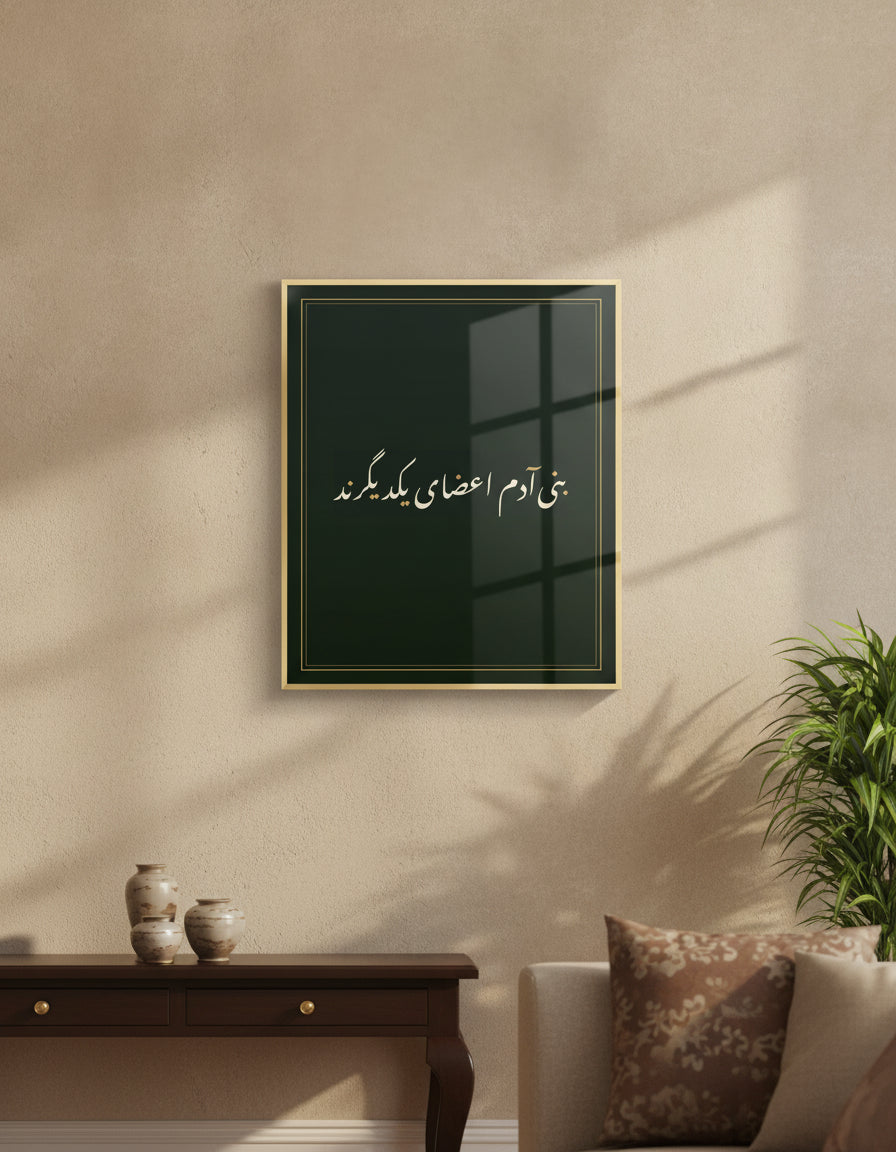
"Bani Adam" is a passage of three couplets by the Persian poet Saadi (1210–1291), from the first chapter of his Golestan. It opens «بنی آدم اعضای یکدیگرند», "the children of Adam are limbs of one another", and says that when one limb is in pain the others cannot rest. A Persian carpet carrying the poem, a gift from Iran in 2005, hangs at United Nations headquarters in New York. Below: the full Persian text, a transliteration, a line-by-line English meaning, the story it comes from, the famous variant, and what the UN connection really is.
The full text in Persian
«بنی آدم اعضای یکدیگرند / که در آفرینش ز یک گوهرند»
«چو عضوی به درد آورد روزگار / دگر عضوها را نماند قرار»
«تو کز محنت دیگران بیغمی / نشاید که نامت نهند آدمی»
This is the text of Golestan, chapter 1, story 10, as given on Ganjoor, the online library of Persian poetry.
Transliteration
Bani Adam a'za-ye yekdigarand / ke dar afarinesh ze yek gowharand.
Cho 'ozvi be dard avarad ruzegar / degar 'ozvha ra namanad qarar.
To kaz mehnat-e digaran bi-ghami / nashayad ke namat nahand adami.
 «بنیآدم اعضای یکدیگرند» — Calligraphy Paint
From 65 SR
 «بنیآدم اعضای یکدیگرند» — Calligraphy Paint · Farsi Nastaliq
From 65 SR
 «باران که در لطافت طبعش خلاف نیست» — Calligraphy Paint
From 65 SR
A line-by-line English meaning
- "The children of Adam are limbs of one another, for in their creation they are of one essence." The word «گوهر» means both essence and jewel.
- "When the world brings one limb to pain, the other limbs can find no rest."
- "You who feel nothing at the suffering of others, it is not fitting that they call you human." The last word, «آدمی», "a human", answers the first, «آدم», Adam: the poem ends where it began.
The English verse rendering on the UN carpet begins "All human beings are members of one frame, / Since all, at first, from the same essence came." It rhymes well and drifts a little: Saadi does not say "one frame" but "one another".
Where it comes from: Golestan, chapter 1, story 10
The Golestan, "the rose garden", is Saadi's book of short stories in prose with verse between them, and its first chapter is on the conduct of kings. In story 10, Saadi is keeping vigil at the tomb of the prophet Yahya, John the Baptist, in the great mosque of Damascus. An Arab king known for injustice comes to pray and asks the poet to pray for him against a powerful enemy. Saadi answers: show mercy to your weak subjects, and you will not suffer from a strong enemy. The three couplets follow. They are, in their place, advice to a ruler: the pain of the weakest subject is the king's own pain.
The title phrase is Arabic as well as Persian: «بنی آدم», "the children of Adam", is the Qur'an's phrase in «ولقد كرمنا بني آدم», "and We have honoured the children of Adam" (al-Isra 17:70). The image of one body is close to an authentic hadith: «مثل المؤمنين في توادهم وتراحمهم وتعاطفهم مثل الجسد إذا اشتكى منه عضو تداعى له سائر الجسد بالسهر والحمى», "the believers in their love, mercy and kindness to one another are like one body: when one limb aches, the whole body responds with sleeplessness and fever" (Sahih Muslim 2586).
«یکدیگرند» or «یک پیکرند»?
Many people quote the first line as «بنی آدم اعضای یک پیکرند», "the children of Adam are limbs of one body". It sounds tidier, but it is not what the manuscripts say. The old copies read «اعضای یکدیگرند», "limbs of one another"; the scholar Abolfazl Khatibi, drawing on Gholam-Hossein Yousefi's commentary on the Golestan, notes that the "one body" reading is found in no manuscript, old or new. "Limbs of one another" is also the stronger thought: we are not parts of an abstract whole, we are parts of each other.
The United Nations connection, stated exactly
It is often said that the poem is inscribed at the entrance of the United Nations. The UN's own catalogue of gifts says something more precise: a Persian carpet woven by Mohammad Seirafian, given by Iran in 2005 to honour the UN's "Dialogue among Civilizations", carries Saadi's poem with an English rendering, and it hangs in the Conference Building, on the second floor, at UN headquarters in New York. It is a carpet inside the building, not an inscription over the door.
On a wall
The line suits a clinic, a school corridor, a charity office, or a family home that has taken people in. We set the first line in Nastaliq, the hanging script the Golestan has long been copied in, in two designs: ivory and gold on deep green, and a plain Nastaliq version. Both are calligraphy paints printed on cotton canvas: A3 rolled from AED 60, A3 framed AED 100, A2 framed AED 195. From the same chapter of the Golestan comes «باران که در لطافت طبعش خلاف نیست», "the rain, whose gentleness none disputes", also from AED 60. The other Persian lines we make are in Persian Poetry in Nastaliq.
If you want all three couplets on one canvas, open the Bani Adam page in Mashq Studio, where the first line opens ready to edit, and add the rest; the Studio is free, and you can order the result as a paint. More of the poet is on the Saadi page.
Quick answers
Who wrote the Bani Adam poem? Saadi of Shiraz (1210–1291); it is in the Golestan, chapter 1, story 10.
Is the Bani Adam poem at the United Nations? Yes, on a Persian carpet given by Iran in 2005, which the UN's gifts catalogue places in the Conference Building of its New York headquarters.
Is it «یکدیگرند» or «یک پیکرند»? The manuscripts read «اعضای یکدیگرند», "limbs of one another"; "one body" is a later popular reading.
Every paint is made to order in our workshop in 5–7 working days, and a rolled canvas travels by Emirates Post Express for the shipping rate shown at checkout.
Keep reading: 43 Arabic Phrases for Wall Art, With Their Meanings · Arabic Calligraphy Scripts Explained. To set the poem in Nastaliq yourself, open Mashq Studio, free.
About this guide: written by MASHQ, which makes Arabic calligraphy pieces to order in its own workshop (1click2open LLC). The Persian text follows Ganjoor; the verse is quoted from the Qur'an with its sura and verse, the hadith with its collection and number, and the UN fact from the UN's own gifts catalogue. Prices were checked against the shop in October 2026.